Lord Mahavira
Lord Mahavira is often credited with the advent of Jainism in India.
However, Jainism existed even before Lord Mahavira was born. He is
supposed to be the twenty-fourth (last) Tirthankara according to the
Jain philosophy. A Tirthankara is an enlightened soul who is born as a
human being and attains perfection through intense meditation.
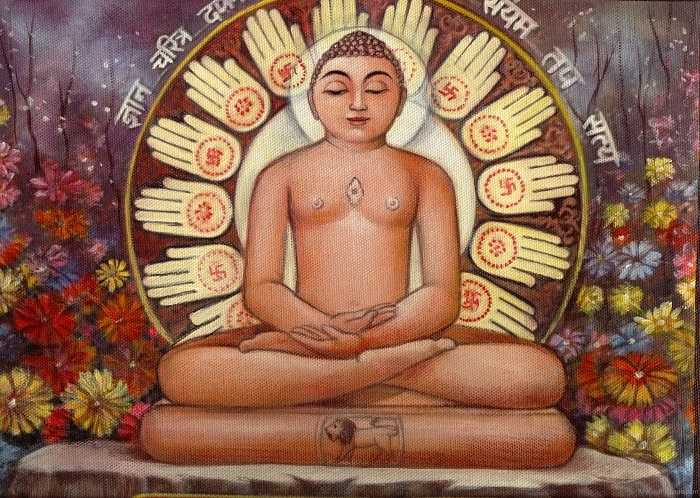
Name: Vardhamana
Birth: 599 B.C.
Birth Place: Kshatriyakund, Vaishali (in modern day Bihar)
Parents: Kingh Siddhartha and Queen Trishala
Spouse: Yashoda
Children: Priyadarshana (daughter)
Titles: Mahavira, Trirthankar, Jina
Age of Attaining Kevala Jnana: 42 years
Ideology: Jainism
Death: 527 B.C.
Age of attaining Moksha: 72 years
Lord Mahavira was the twenty-fourth and last Jain Tirthankara
according to the Jain philosophy. A Tirthankara is an enlightened soul
who is born as a human being and attains perfection through intense
meditation. For a Jain, Lord Mahavira is no less than God and his
philosophy is like the Bible. Born as Vardhamana Mahavir, he later came
to be known as Bhagvan Mahaveer. At the age of 30, Vardhamana left his
home in pursuit of spiritual awakening, and for the next
twelve-and-a-half years, he practiced severe meditation and penance,
after which he became omniscient. After achieving Kevala Jnana, he
travelled throughout the Indian subcontinent to teach Jain philosophy
for the next 30 years.
Early Life : Lord Mahaveera was born Prince Vardhamana to King Siddhartha and
Queen Trishala of the Ikshvaku Dynasty. He was born in 599 B.C. on the
thirteenth day of the rising moon during the month of Chaitra in the
Vira Nirvana Samvat calendar. According to Gregorian calendar,
Vardhamana was born during the month of March-April, which is when
Mahaveer Jayanti is celebrated today. Most historians agree that he was
born in Kshatriyakund in the Kingdom of Vaishali which is in modern day
Bihar.
When Queen Trishala was pregnant with Vardhamana she had the 14
dreams depicted in Jain scriptures indicating that her unborn child was
destined to greatness. His parents were followers of the Jain ascetic
Parashwanatha. As a child Vardhamana was quiet but brave. He displayed
acts of great courage several times during difficult situations. Being a
prince he was brought up amidst much luxury yet nothing affected him.
He led a very simple life. Following his parent’s instructions, he
married Princess Yashoda, at a very young age and the couple had a
daughter, Priyadarshana. The Digambara sect of Jainism believes that
Vardhamana refused to get married when his parents insisted.
Renunciation : When Vardhamana was 28, his parents passed away and his elder brother
Nandivardhana succeeded their father. Vardhamana craved freedom from
the worldly attachments and sought his brother’s permission to renounce
his royal life. His brother tried to dissuade him from his resolve but
Vardhamana was adamant, practicing fast and meditation at home. At 30
years of age, he finally abandoned his home and embraced the ascetic
life of a monk on the tenth day of Margsirsa. He gave away his
possessions, put on a single piece of cloth and uttered “Namo Siddhanam”
(I bow down to the liberated souls) and left all his worldly
attachments behind.
Penance and Omniscience : Mahavira spent the next twelve and a half years pursuing a life of
hard penance to drive away his basic attachments. He practiced complete
silence and rigorous meditation to conquer his basic desires. He assumed
a calm and peaceful demeanor and sought to overcome emotions like
anger. He discarded his clothes and put himself through immense
hardships. He practiced a philosophy of non-violence against all living
being. He moved from place to place, often observing fasts and sleeping
for only 3 hours each day. During his twelve years of penance he
travelled through Bihar, western and north Bengal, parts of Orissa and
Uttar Pradesh.
After experiencing 12 years of hard penance, a tired Mahaveera is
said to have fallen asleep for a few moments when he experienced a
series of 10 strange dreams. These dreams and their significance have
been explained in Jain Scriptures as follows:
1. Defeating a Lion – signifies destruction of ‘moha’ or worldly attachment
2. A bird with white feathers following him – signifies attainment of purity of mind
3. A bird with multicolored feathers – signifies attainment and propagationof multifaceted knowledge
4. Two gem strings appear in front – symbolizes preaching a dual
religion, an amalgamation of principles from a monk’s life and duties of
a common man.
5. A herd of white cows – symbolizes a group of devoted followers who will serve
6. A pond with open lotuses – symbolizes presence of celestial spirits who will propagate the cause
7. Crossed a waxy ocean swimming – symbolizes freedom from the cycles of death and rebirths
8. Sun rays spreading in all directions – symbolizes attainment of Kevala Jnana (Omniscience)
9. Encircling the mountain with your bluish intestines – symbolizes the universe will be privy to the knowledge
10. Sitting on a throne placed on summit of the Mount Meru –
symbolizes people revering the knowledge being taught and placing
Mahaveer in a place of respect.
On the tenth day of the rising moon during the month of Vaisakh, 557
B.C., Mahavira sat under a Sal tree on the banks of river Rijuvaluka
(modern day river Barakar), and attained the Kevala Jnana or
omniscience. He finally experienced perfect perception, perfect
knowledge, perfect conduct, unlimited energy, and unobstructed bliss. He
became a Jina, the one who is victorious over attachment.
Spiritual Journey : According to Jain scriptures, Mahavira held Samavasarana (a preaching
pavillion) to spread his knowledge among the common people. His first
Samavasarana was not successful and he held a second one at the city of
Pava in the garden of Mahasena. Here his words of wisdom resonated with
the masses, and eleven Brahmins chose to embrace his preaching and
convert to Jainism. These eleven Brahmins namely, Achalbhadra,
Agnibhuti, Akampita, Indrabhuti, Mandikata, Mauryaputra, Metarya,
Prabhasa, Sudharma, Vayubhuti, and Vyakta, became his chief disciples or
Gandhars. Lord Mahavira imparted the Tripadi Knowledge (Three
Pronouncements) to his chief disciples which where Upaneiva (Emergence),
Vigameiva (Distruction) and Dhuveiva (Permanence).
Organization : The eleven chief disciples of Mahavira brought their own followers
into the fold of his teachings. These 4400 followers became first of the
Jain Shramanas. Eventually common people also joined his order and
Mahaveer ultimately lead a community of 14,000 monks (muni), 36,000 nuns
(aryika), 159,000 laymen (shravakas) and 318,000 laywomen (shravika).
These four groups constitute the fourfold order or four tirthas of
Jainism. Some of his royal followers included King Chetaka of Vaishali,
King Shrenik Bimbisar and Ajatshatru of Rajagriha, King Udayana, King
Chandrapadyot, Nine Licchavis Kings of Koshal and Nine Kings of Kashi.
Nirvana : Mahavir devoted his life towards spreading his Keval Jnana among
people and gave discourses in local languages as opposed to in elite
Sanskrit. His final discourse was at Pavapuri which lasted for 48 hours.
He attained moksha shortly after his final discourse, finally liberated
from the cycle of life, death and rebirth during 527 B.C. at the age of
72.
The spiritual philosophy of Lord Mahavira encompasses eight cardinal
principles – of them three metaphysical and five are ethical. Jains
believe in the eternal existence of the Universe - neither it was
created and nor can it be destroyed. Mahavira thought that the Universe
is made up of six eternal substances – Souls, Space, Time, Material
Atoms, Medium of Motion and Medium of Rest. These independent components
undergo changes to create the multifaceted reality that mortals exist
in. Lord Mahavira introduced the philosophy of Anekantvada (principle of
non-absolutism) that refers to pluralism of existence. It teaches that
truth and reality may differ when perceived from different points of
views, and that no single view represents the absolute truth. This
multifaceted reality is better explained with Syadvada or the Principle
of Seven Fold Predictions. The principle of Partial Stand Points or
Nayvada is also an offshoot of Anekantvada, reinforcing the Jain belief
of existence of infinite points of view, each expressing a partial
truth.

Comments
Post a Comment